|
| Nicopolis ad Istrum |
|
|
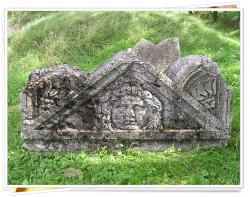 Nicopolis ad Istrum (Greek: Νικόπολις η προς Ίστρον) was a Roman and Early Byzantine town founded by Emperor Trajan around 101–106, at the junction of the Iatrus (Yantra) and the Rositsa rivers, in memory of his victory over the Dacians. Its ruins are located at the village of Nikyup, 20 km north of Veliko Tarnovo in northern Bulgaria. The town reached its apogee during the reigns of Trajan, Hadrian, the Antonines and the Severan dynasty.
The classical town was planned according to the orthogonal system. The network of streets, the forum surrounded by an Ionic colonnade and many buildings, a two-nave room later turned into a basilica and other public buildings have been uncovered. The rich architectures and sculptures show a similarity with those of the ancient towns in Asia Minor. Nicopolis ad Istrum had issued coins, bearing images of its own public buildings.
In 447 AD, the town was destroyed by Attila's Huns. Perhaps it was already abandoned before the early 400s. In the 6th century, it was rebuilt as a powerful fortress enclosing little more than military buildings and churches, following a very common trend for the cities of that century in the Danube area. The largest area of the extensive ruins (21.55 hectares) of the classical Nicopolis was not reoccupied since the fort covered only one fourth of it (5.75 hectares), in the southeastern corner. The town became an episcopal centre during the early Byzantine period. It was finally destroyed by the Avar invasions at the end of the 6th century. A Bulgarian medieval settlement arose upon its ruins later (10th-14th century).
Nicopolis ad Istrum can be said to have been the birthplace of Germanic literary tradition. In the 4th century, the Gothic bishop, missionary and translator Ulfilas (Wulfila) obtained permission from Emperor Constantius II to immigrate with his flock of converts to Moesia and settle near Nicopolis ad Istrum in 347-8. There, he invented the Gothic alphabet and translated the Bible from Greek to Gothic.
Nicopolis ad Istrum is an important site and is visited by thousands of Bulgarian and foreign tourists and many specialists. It has been declared a monument of culture and scrupulous care is taken of further excavations, investigation and popularization.
|
| Monday, Jun 07, 2010 |
|
|
|
|
| » RENTALS |

|
|
|
| Studio |
€ 155 |
|
| Location: |
Veliko Tarnovo |
|
|

|